
Copium: Why I Stopped Wanting the Most Prestigious Job in Tech
Hint: it's because of trust & safety

This is a post that I really couldn’t publish while I was employed, so I’m taking the time to do it now. It’s mainly aimed at those who’ve been rejected for employment by the prestigious AI companies, those like myself.
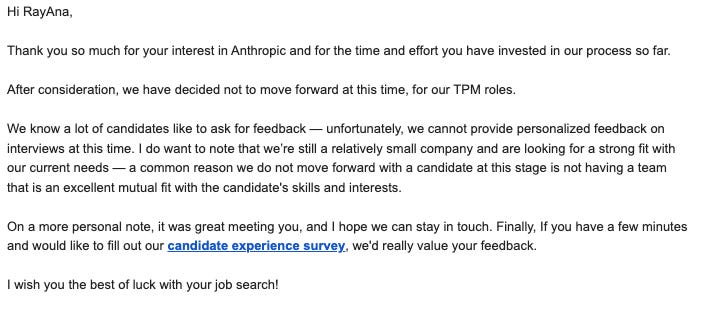
Yes, I was turned down by both Anthropic and OpenAI – I cold applied to one and was discovered by a recruiter for the other, passed the phone screen, passed the first round of interviews, but failed to move onto the full loop. When I applied to Anthropic 2.5 years ago, I was pregnant and I figured hearing back from them would be a longshot. But I got a callback and after speaking with the recruiter, I made the mistake of agreeing to interview postpartum, closer to when I would actually be able to start employment (if I passed). I didn’t realize how kneecapped I would be with the lack of sleep and distance from my active work life. What did I work on and what were the key challenges? Completely forgot. It didn’t help that the interviewer for the technical round was asking me rapid fire questions and set the expectation to answer each in under 3 minutes – but if that’s the culture over there, then maybe I dodged a bullet. I’m a slow thinker (especially at 4 months postpartum), not a great (verbal) storyteller, and I bombed it pretty badly.
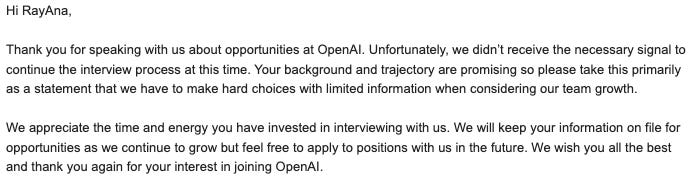
The interview with OpenAI was more recent, but I think I had given myself a “C+” at best with my answers so I knew I didn’t make the cut. Interview prep is a full-time job, and if you have small kids without someone to help watch them for a few days (so you’re well-rested), it’s hard to prioritize time for this among all your other responsibilities. It is what it is, and I accept the tradeoffs.
While employed, I had the luxury of being picky about where I wanted to work next. (Whereas currently, I’m taking an intentional career break but open to exploring any opportunity.) As I was making that assessment, the reason why the frontier model companies were appealing to me is because as someone in the Trust & Safety ML space myself, I felt that I would be able to bring value there as a Technical Program Manager – not just as someone who had the hard skills, but as someone who deeply cares about the safety of the end users, about humans in general. Seeing as these companies were having a large impact on the world, I had changed my tastes from wanting to stay in the gaming space (previously at Curse and Twitch), to being in Trust & Safety where I can help technology be a benefit to society, and to mitigate the harms that it can cause. Pandora’s box has been opened, and if this ship is going down, I’m not gonna go down without a fight, without trying to contribute what I can to this space.
But this is a hard space to be in. Every time there’s some salacious article published about some company being at fault for the egregious harms that it caused people, the media only covers the outrage because that’s the only thing it has access to cover. What goes on behind the scenes is a different story, protected by attorney-client privilege, of people like me working double-duty to put out the fires, retrace our steps on what went wrong, figure out what mitigations we can put in place for an incident, which involves many people and cross-functional teams thinking through all the edge cases while ensuring we “balance it with the business.” If that last part makes you feel awful, it makes us feel awful too, but the alternative would be to shut down the entire site or service altogether so instead, we have to figure out how far we can edge away from harm without shutting the whole thing down.
As someone who has run the Safety by Design program at Twitch (which has tens of millions of users), I have spoken with others who’ve run similar programs at other tech companies and the sentiment is the same: we’re trying the best that we can to keep users safe, with the limited resources that we have, while feature teams are simultaneously trying to ship as quickly as possible. To me, it’s not a role to rest and vest in, you are in it because you care. But caring is also exhausting.
Frontier model companies are a bit different from other types of companies because their tools are so powerful and “with great power comes great responsibility” – it can be wielded for both good and nefarious purposes, and anyone can use it to execute what they want to do at scale. From harmless doc summarization to annoying AI slop to unspeakable deepfakes, it’s the model companies that are ultimately responsible for the safety of what they publish. And as we all know, the users at the fringes will always be there to see how much harm they can do with anything they can get their hands on.
Can you imagine being at one of these companies and feeling like the company you are working for is responsible for someone committing suicide? There was a time when video games and music were blamed for mass violence. But those are essentially static artifacts. Marilyn Manson didn’t hand a weapon to anyone. The artifact was consumed, and then a human made a choice. Someone made a thing, another person did a thing, those were separate events. The artifact couldn’t help you do the harm.
With AI, the causal chain is more direct and participatory. The model doesn’t just inspire – it assists, generates, and executes in response to what you’re asking it to do. The tool is dynamic and participates in the act. It’s less like “I played this violent game and then did something” and more like “I had a collaborator who helped me do it step by step.” Working at a frontier model company is closer to being a co-author of whatever the model helps someone do. And for the trust & safety folks, the burden is different from any T&S team before them.
So with all that in mind, is that something I have the mental fortitude for? To be a part of a team/company trying our best but not really being able to speak to that because of the fact that it’s wiser to keep that behind closed doors? If I had the opportunity, I think I would still try, but that is also why I’m not too bummed about not working there – because I know I would put my whole self into something that I would again potentially burn out from.
Besides, it seems like their jobs are changing underneath them as we speak. Anthropic just published an essay about recursive self-improvement: the models are now writing the models. Their own engineers are shipping 8x more code than they were a year ago, and some haven’t written a line themselves in months. The ship is accelerating and the people responsible for its safety are simultaneously trying to steer it. The pressure must be incredible.
So yeah, I don’t envy the people who work at frontier labs like OpenAI or Anthropic right now. They know how powerful their models are and what they could be used for, they’re signing contracts with the government that will have material impact on national security and our futures. The folks over there must feel like that first group of scientists working on the Manhattan Project while developing the atomic bomb – both exhilarated because you’re working on something novel and game-changing, and yet disquieted from what it could mean if it went into the wrong hands, which it inevitably will.
All this to say, if you got rejected for a job there, maybe it was a blessing in disguise and you just don’t know it yet. Maybe we dodged a bullet. I know it feels bad in the moment but at this point in the AI era, maybe it’s actually better for our mental health if we just took a less morally conflicting job where we’re not accidentally accomplices to tragic events. At least, that’s my copium.