

I assume humans are behind their art, that they are baring their souls through creative expression. But when I find out it was AI-generated or AI-augmented, I feel deceived. As I’m starting to create more art during my career break, I don’t want others to feel this way by what I create, so I’d like to be transparent about how I use AI and the line I draw with where I incorporate it into my work.
My Background
I have been programming since middle school, was a Computer Science major in college, and later on, earned a Certificate in Predictive Analytics from University of California: Irvine’s Continuing Education program in 2021. All this to say, I have always been technically-minded and have been in the space of software engineering, data science, and machine learning (ML) before the AI hype when ChatGPT started becoming popular. I was interested in the role of Facebook’s psychographic data harvested by Cambridge Analytica to impact the 2016 election, and the general ethics of how algorithms were impacting people’s lives and livelihoods. I joined a mission-driven team in 2021 at Twitch that used ML to keep bad actors off the platform and reduce harm to our community, which aligned well with my personal values. As AI became more accessible to the general population, it became even more necessary to fight fire with fire in order to scale combatting bad actors (while keeping humans in the loop for edge cases). To me, AI is a tool that can be used for good or evil, to put trash into the world or help keep it clean. Currently (in 2026), I feel like much of AI is being used to create trash and I do not want to contribute to that. It does not bring me joy, even if doing that might bring in a quick buck.
My stance is not a judgement on anyone who uses AI for art, because I was once in a place where I had to make ends meet and using genAI for content can be a lucrative business, a way out of a rut. But now I’m in a place where I have the privilege of making a choice, so I personally choose not to, unless it is for fun and experimentation, not exploitation.
What AI does and does not do for me
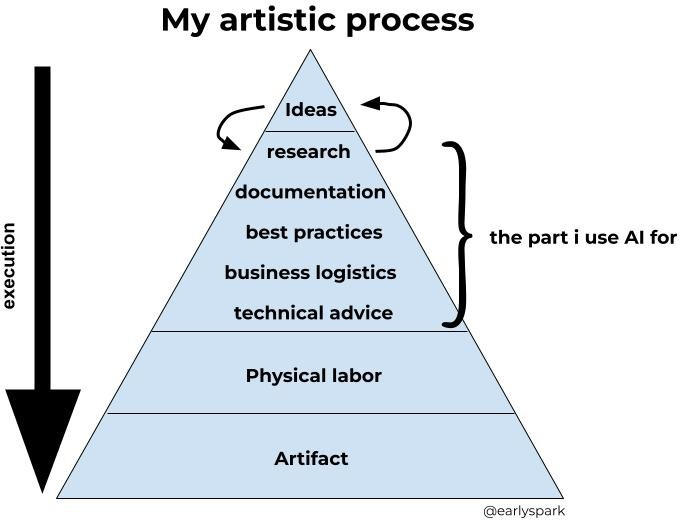
This (non-AI generated) image illustrates my artistic process and where I use AI for help. In the past, I have indeed tried using AI to come up with original ideas, and even created drawings based on my past sketches. After experimenting with that, I decided it’s just not up to my quality bar. Although the problem-solving act of figuring out how to use a local model to produce new sketches was a fun learning opportunity, I don’t get the same personal fulfillment from it, so instead, I myself come up with the original vision for what I want the end result to be. I do not lack ideas.
To get to the final artifact though, I need to vet whether it’s even feasible. If it’s going to be a piece where mistakes will be costly, I would rather do research first to see what materials I should be using, or what thickness a metal sheet should be, or what kind of solder I should use. If it’s something I need a 3D render for, to see how the pieces will move before I cut it out, I would rather not spend time trying to figure out the software to do this. I have taken classes on woodshop, metalshop, jewelry smithing, painting, drawing, etc, but I’ve forgotten a lot of the lessons. However, I still have textbooks as reference, in addition to the internet and AI, which I use as an information aggregator – a conglomeration of lessons combined. There is nothing new under the sun, everything has been done.
The other thing I use AI for is help with understanding the logistics of the business, the administration type stuff: figuring out how to set up a shop, coming up with SEO-friendly headlines and meta descriptions, and advising on how to market and potentially price my work.
For some things, I am learning from my predecessors, but for other things, you can really only learn through physical labor and experience. AI doesn’t make the physical media for me. That’s done either with my hands or through a machine like a laser cutter. I’m still the one that cuts the paper, strikes the torch, hammers the metal. I outsource the research so I can execute the actual physical work that needs to be done, and I learn by doing so I can understand the nuances of how it feels to hold a saw correctly, how much water to use with my pigments – water doesn’t wait to dry for me to Google what to do next.
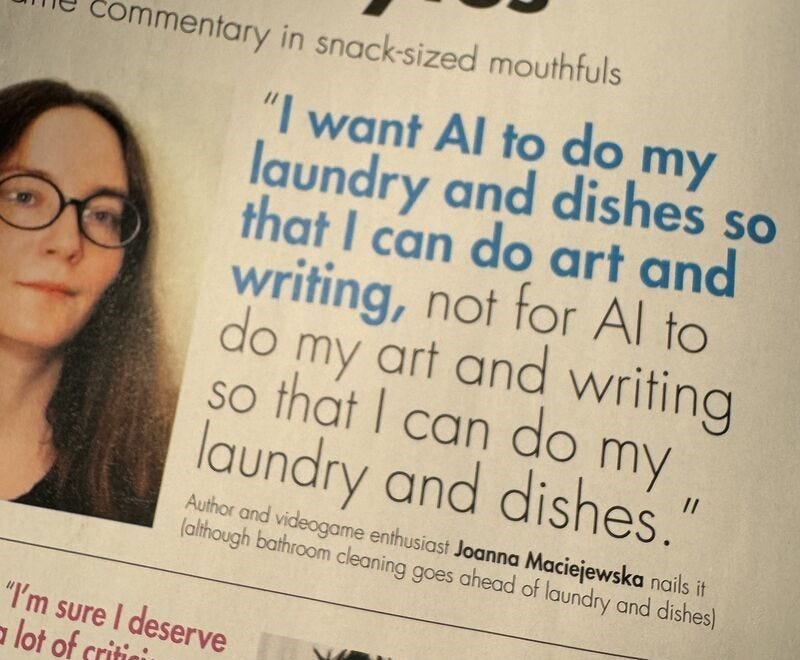
This does not mean I will never use AI for generating content (not art), like images for blog posts. But if ever I do find myself using AI for art, for either the idea-generation or the final artifact, I would disclose that alongside my work. If ever AI can do the physical labor part, I will send it to do my household chores.
Final thoughts
When I worked in corporate, and AI adoption was starting to become a thing, I thought having an AI Diligence Statement was important, but now with experience, I can tell if writing “sounds like” AI, and I assume all documents are created with some kind of AI help at this point. But as dead internet theory manifests, I am increasingly looking for authentic thoughts and original pieces of work, and therefore, I’m inclined to do my part and contribute with my own.
As a person who creates art but also has a tech background, I felt the need to reconcile this polarizing topic for myself. I understand that haters gonna hate, but I’m at peace with how I am using AI for myself in my artistic process.
(No AI was used in writing up this statement, but it was used to fix grammar mistakes.)